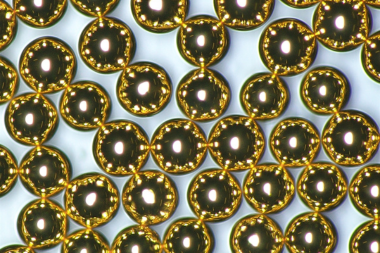
Selection Guide for “Microparticles” to Achieve Precise Gap Control and Stress Relief
2026-05-08
In semiconductor packaging and electronic material bonding/adhesion, are you facing challenges such as “gap precision,” “stress concentration,” and “dispersion stability”?
These challenges can be significantly improved through proper microparticle selection.
In this article, we explain how differences in particle size, material, and physical properties affect functionality, and provide easy-to-understand guidelines for selecting the optimal microparticles for each application.
Key Challenges Solved by Microparticle Selection
- Difficulty in maintaining precise and stable gaps
- Challenges in balancing conductivity and insulation
- Stress concentration at bonding interfaces due to thermal cycling
- Processing defects caused by filler sedimentation or agglomeration
What Are Microparticles? Their Role in Functional Material Design
Microparticles are not just additives, but essential materials for designing the following functions.
- Conductivity enhancement
- Gap control (spacer function)
- Stress relief
- Optical property adjustment
- Viscosity control
Functional Differences by Particle Size
This article systematically organizes spherical microparticles from the perspectives of “particle size” and “material,” and explains selection guidelines based on applications.As shown in Table 1, in the submicron range (≤1 μm), chemical interactions at the interface with the medium become dominant. Therefore, these particles are commonly used for applications such as catalysis, optical control, and viscosity adjustment. In contrast, for particles larger than 1 μm, mechanical properties and dimensions become the dominant factors. As a result, they are often used in applications requiring precise gap control and stress relief.
| Particle Size | Dominant Factors | Key Functions | Typical Applications |
|---|---|---|---|
| ≤ 1 μm | Surface energy / Specific surface area | Conductivity enhancement, catalytic activity, optical property control, viscosity adjustment | Conductive additives, catalysts, optical fillers |
| 1–10 μm | Particle size precision / Dispersion stability | Precise gap control, optical control, anti-blocking | Adhesive spacers, optical fillers, conductive particles |
| 10–600 μm | Elastic modulus / Compression properties | Stress relief, thickness control, gap retention | Semiconductor device spacers, stress-relief materials |
Material Characteristics and Selection Points
This article also summarizes representative types of microparticles by material. Please refer to Table 2. Metal and inorganic oxide particles offer high conductivity but often face challenges in sedimentation and dispersion due to their high density. Inorganic oxide particles, including glass, exhibit excellent dimensional stability and heat resistance. However, their high rigidity may pose a risk of damage to substrates and base materials. On the other hand, polymer particles provide controllable elasticity, insulation, and stress-relief properties, making them widely applicable across various substrates and applications. Additionally, conductivity can be imparted by forming a metal layer on the surface of polymer particles (metal-coated polymer particles).
| Material | Characteristics | Advantages | Challenges | Main Applications |
|---|---|---|---|---|
| Metal particles | High conductivity, high density | Low resistance, excellent conductivity | Prone to sedimentation, dispersion challenges | Conductive pastes, electrode formation |
| Carbon particles | Lightweight, conductive | Good dispersion, low density | Relatively high contact resistance | Conductive additives, cathode materials |
| Inorganic oxide particles (silica, glass, etc.) |
High rigidity, high heat resistance | Dimensional stability, heat resistance | Risk of substrate damage | Optical adjustment, viscosity control |
| Polymer particles | Low density, controllable elasticity | Stress relief, dispersion stability | No conductivity | Spacers, stress-relief materials |
| Metal-coated polymer particles | Conductivity + low density | Combines stress relief and conductivity | Manufacturing cost | Conductive adhesives, ACF |
Differences in Microparticles from a Physical Property Perspective
| Material | Shape | Density | Elastic Modulus |
|---|---|---|---|
| Metal particles | Spherical (varies by metal type) | > 7 | ₋ |
| Carbon particles | Non-spherical | Approx. 1.6–1.8 | ₋ |
| Inorganic oxide particles (silica, glass, etc.) |
Spherical / True spherical | Approx. 2.5–5 | Approx. 70 GPa |
| Metal-coated polymer particles | True spherical (perfect sphere) | Approx. 1.1–2.5 | Several hundred MPa to several GPa |
| Polymer particles | True spherical | Approx. 1.0–1.2 | Several hundred MPa to several GPa |
How to Select Microparticles by Application
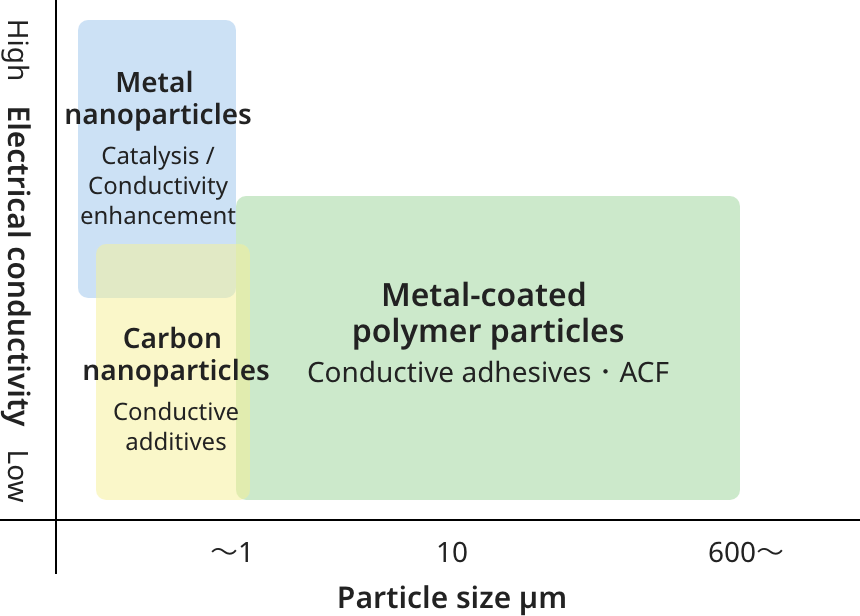
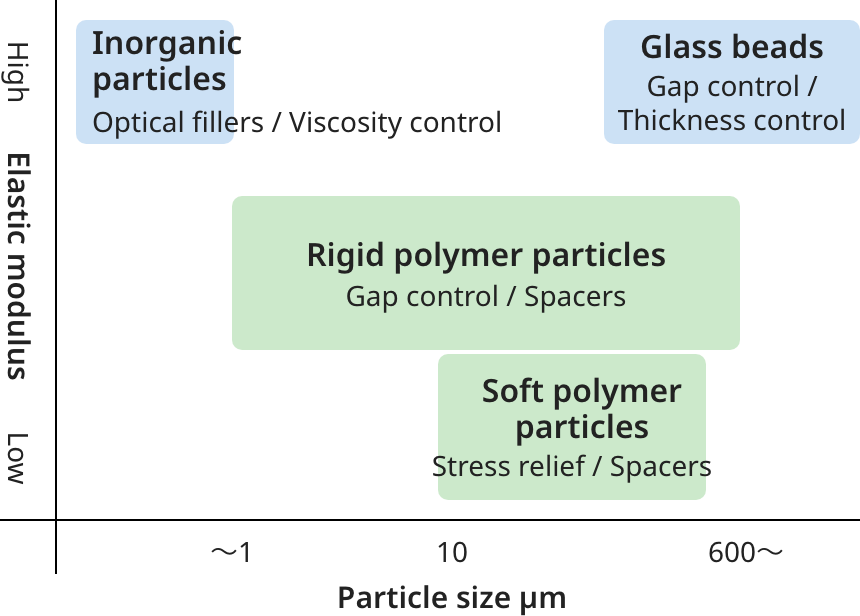
Figure 1 shows application examples based on particle size and material. In the submicron range (≤1 μm), metal nanoparticles and carbon nanoparticles are widely used due to their high specific surface area, enabling conductivity and catalytic activity. Silica fillers are also commonly used for optical property control and viscosity adjustment. Polymer particles, ranging from 1 μm to 600 μm, offer high dimensional precision and a wide size range, making them highly advantageous for applications requiring precise gap control and stress relief compared to other materials.
Summary
The functions of microparticles vary significantly depending on the combination of particle size and material.
- Nanoparticles: conductivity, catalysis, optical functions
- Microparticles: gap control, stress relief
- Metal particles: high-conductivity applications
- Inorganic particles: heat resistance and optical applications
- Polymer particles: spacer and stress-relief applications
Selecting the appropriate particle size and material according to the application is key to improving product performance and reliability.
High-Performance Microparticles from SEKISUI CHEMICAL
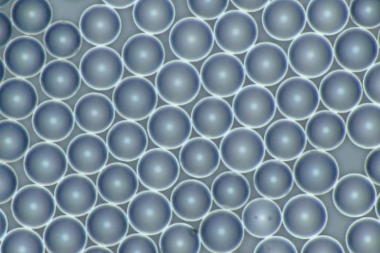
Our polymer microparticles, Micropearl™, offer excellent dimensional stability and a wide lineup with different elastic moduli. They also feature surface properties that enable compatibility with various dispersion media.
For more details, please visit:
Features & Lineup:
- Polymer particles:https://www.sekisuichemical-hppc.com/en/products/detail/190/
- Metal-coated polymer particles:https://www.sekisuichemical-hppc.com/en/products/detail/241/
_ミクロパール™_png_w500px_h333px.png)