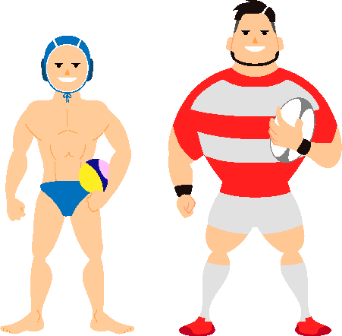



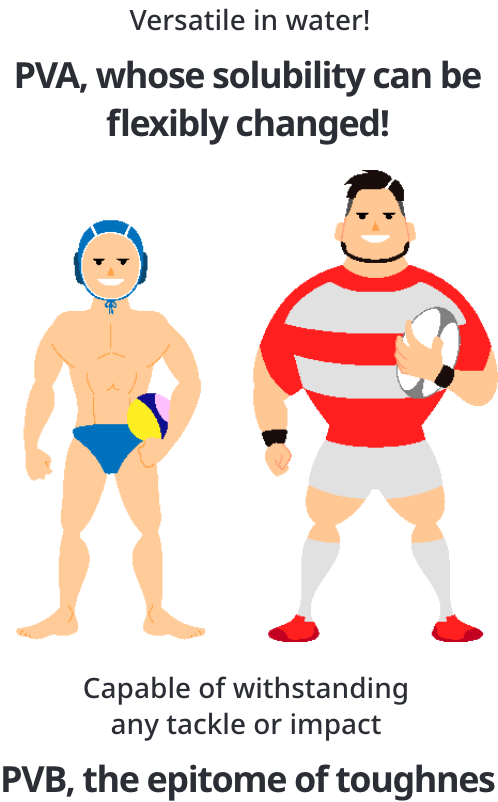
“Water polo players,” who excel in aquatic activities, and “rugby players,” who are the epitome of toughness
What is PVA?
“An adhesive, water-soluble plastic”
PVA is an abbreviation for polyvinyl alcohol. It is a type of plastic. It has many OH groups (hydroxyl groups) with an affinity for water (H2O) and is characterized by excellent water solubility. PVA becomes adhesive when dissolved in water and forms a strong film when it becomes dry.
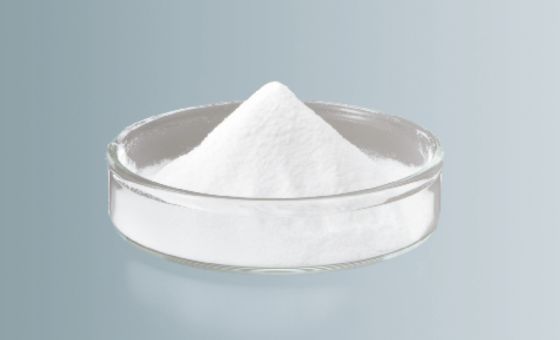
Familiar products in which PVA is used
Laundry detergent films and water glues
PVA is used in everyday items. At home, it is used in laundry detergent films and water glues, which is a type of stationery used for crafting, etc. PVA is an indispensable material used in various products in our daily lives.
What is PVB?
An adhesive, strong plastic
PVB is an abbreviation for polyvinyl butyral. It is a type of plastic made mainly from PVA. It becomes soft when heated and achieves excellent bonding to glass and metals. It is also very strong and resistant to impact, and does not easily crack or tear.
Familiar products in which PVB is used
Automotive windshields and architectural window glass
PVB is often processed into a sheet film, which is placed between two sheets of glass. It is used in automotive windshields and architectural window glass. PVB is an essential component and is crucial to underpin our safe and comfortable living.

How are PVA and PVB likened to athletes?
PVA is similar to a water polo player.
Why is PVA similar to a water polo player?
Water polo players are so adept at underwater activities that they can play the ball game in water. Similarly, PVA can freely control the relationship with water, including water solubility. A water polo player who plays the ball game in water (PVA) can transform into a rugby player to play sport on land (PVB).
PVB is similar to a rugby player.
Why is PVB similar to a rugby player?
A rugby player can withstand any tackle using the body and is literally regarded as a symbol of toughness. Similarly, PVB is a symbol of toughness in the realm of plastics. Its strength helps make our daily lives comfortable. The image of a rugby player is used to explain various features of PVB.
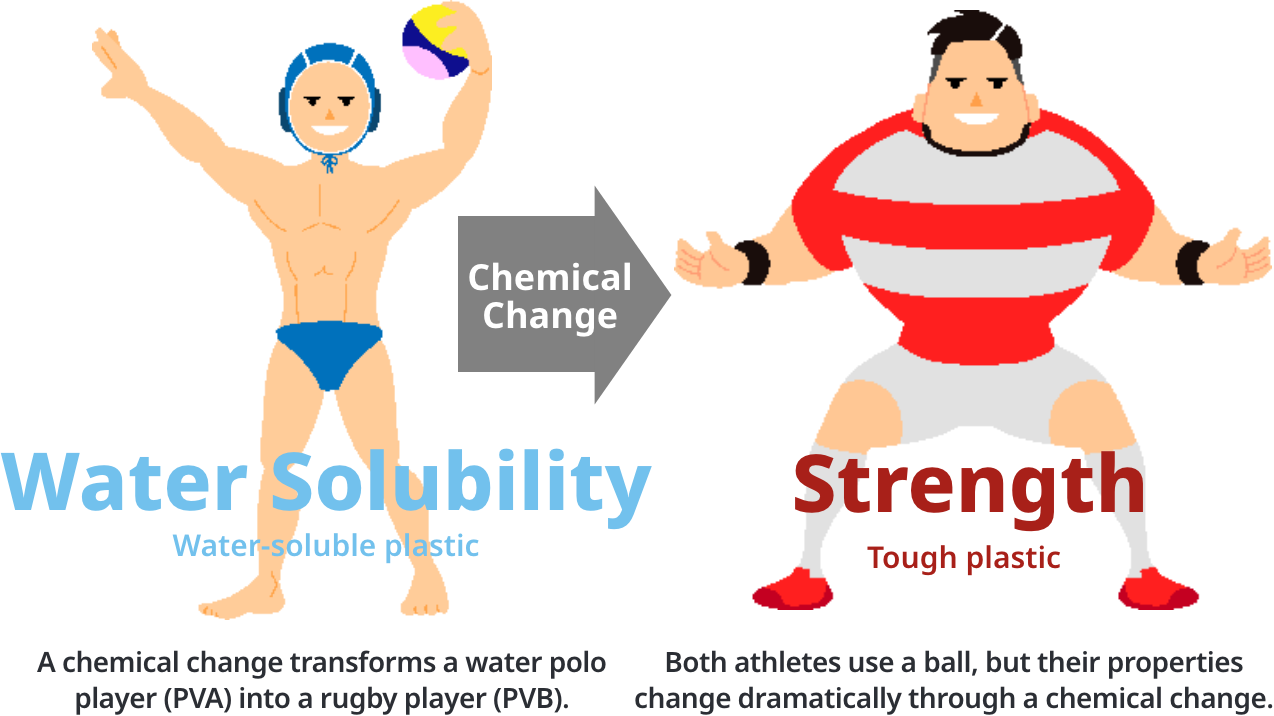
What is the relationship between PVA and PVB?
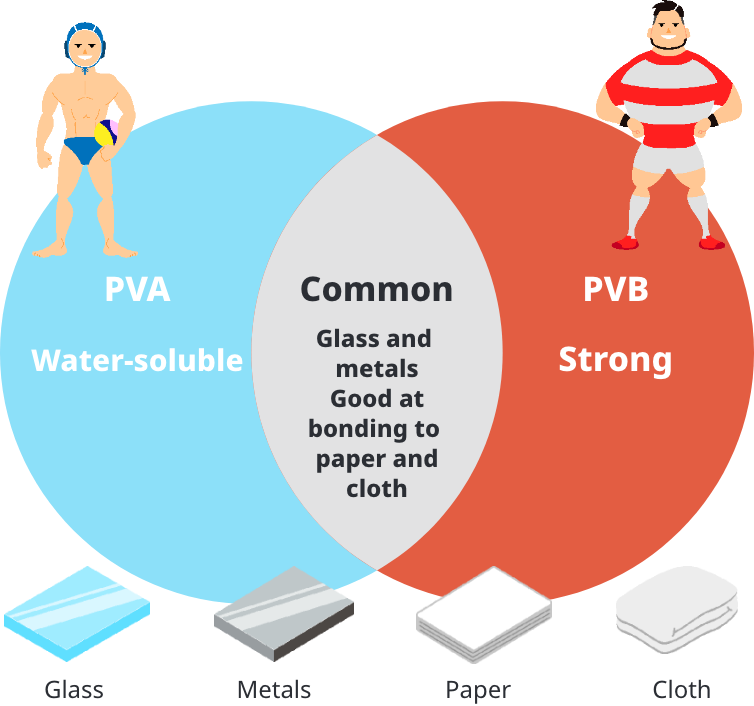
They have many features in common.
PVA and PVB significantly transform themselves through a chemical change, but they also have many features in common. A typical example of common features is adhesion to inorganic substances and fibers. Inorganic substances refer to glass and metals, while fibers include paper and cloth. By leveraging these characteristics, PVA and PVB serve as underlying substances that underpin our daily lives.
8 main features
Strength
Strong and flexible and not damaged even when subjected to a large impact
A rugby player use the robust body to withstand any tackle. PVB-based laminated glass has outstanding impact resistance and penetration resistance and is not easily penetrated even when subjected to a strong impact. Due to proper hardness and flexibility, PVB bends flexibly without snapping when force is applied. Strength is attained by the proper balance of hardness and flexibility.

Adhesiveness
Good at bonding to inorganic substances, such as glass and metals
Both a water polo player and a rugby player are good at sticking (adhering) to inorganic substances and fibers. By taking advantage of such properties and strength, PVB is used as an interlayer film in laminated glass (a PVB film placed between two sheets of glass). PVB is also used in rust-preventive paints for ships and bridges and modifiers, including metallic paints (to overcome weak points and improve functions).
Transparency
Highly transparent
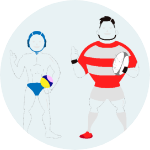
SEKISUI’s water polo and rugby players are also good at becoming transparent. They are not just transparent. Their transparency is so high that they are unnoticeable even when they come into people’s sight. Thus, they are used in window glass and automotive windshields. Their transparency is higher than that of other materials. Although they are transparent and their presence is barely noticeable, they play key roles as essential components.
Color stability
Color-stable and remaining transparent over the long term
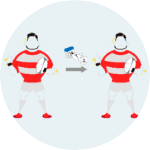
The well-trained physiques of a rugby player remain strong over the long term. Intrinsically, plastics tend to discolor over time. However, PVB is color-stable over the long term. High transparency and color stability help maintain transparency at high levels over the long term. Color stability is one of the reasons why PVB is used in window glass and automotive windshields.
Dispersibility
Capable of uniformly dispersing fine particles
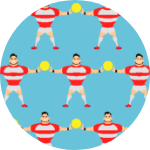
Films with various functions and designs, such as solar control films and colored films, can be created by mixing tiny functional particles into resins. PVA and PVB allow fine particles, which are added to them, to be uniformly mixed without forming lumps and maintain the condition. This is called dispersibility. Stable functionality can be demonstrated by distributing particles evenly. The water polo and rugby players work hard to support particles and prevent them from forming lumps.

Thermoplasticity
Becoming soft when heated
When heated, water polo and rugby players become soft and elastic and can be reshaped into different shapes. PVA and PVB are thermoplastic. They are hard at normal temperature but become soft when heated. Even after being formed, PVA and PVB melt again when heated and can be formed into different shapes.
Water solubility
Dissolved in water
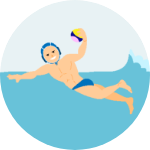
A water polo player can swim flexibly, fast and slow. PVA is a plastic but can be dissolved in water. In addition to being soluble, PVA makes it possible to control solubility. That is, the difficulty and ease of dissolution in water can be controlled. When PVA is used in water-soluble laundry detergent films, solubility control makes it possible to adjust the timing at which the content starts to dissolve.

Safe materials
A highly safe material
Water polo players are highly safe. There is no need to worry even if they accidentally get into the human body. PVA is a highly safe material. PVA is also used in the adhesive on postage stamps. Previously, people licked the back of a postage stamp before sticking it on an envelope or postcard. This testifies to the safety of the material. PVA is used not only for paper but also in laundry starch for clothes.
Applications of PVA/PVB
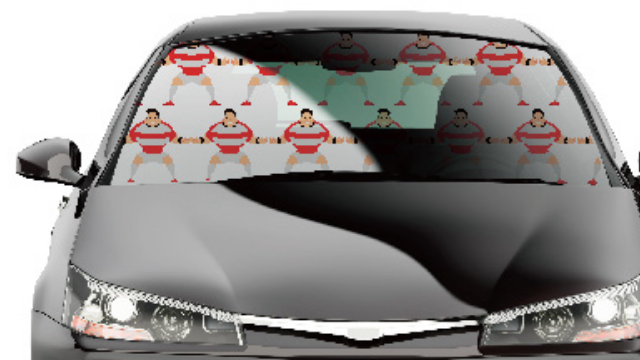
Protecting occupants’ safety with car windshields
PVB is processed into a sheet film called an interlayer film, which is used in automotive windshields. The interlayer film prevents glass from shattering in the event of a collision, such as an accident, and absorbs impact. It also has UV protection and soundproof functions, helping improve comfort in the cabin.
Functions
 Strength
 Adhesiveness
 Transparency
 Color stability
 Thermoplasticity
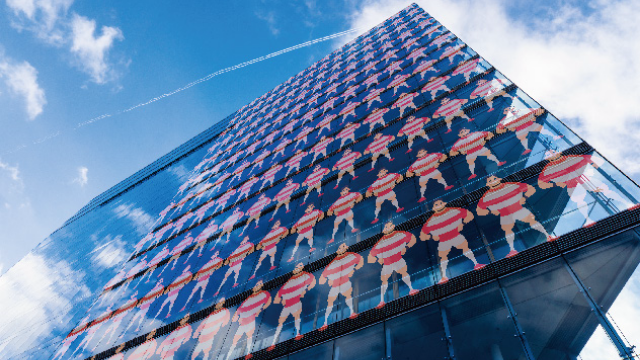
Contributing to safety and comfort through glass of high-rise buildings
An interlayer film is also used in window glass for high-rise buildings. Large glass is often used to seek openness and brightness. Priority is also placed on safety and energy conservation from the viewpoint of disaster preparedness and eco-friendliness. The Solar Control Film prevents temperature rise by blocking infrared rays without blocking visible light, thereby contributing to energy conservation.
Functions
- Strength
- Adhesiveness
- Transparency
- Color stability
- Thermoplasticity
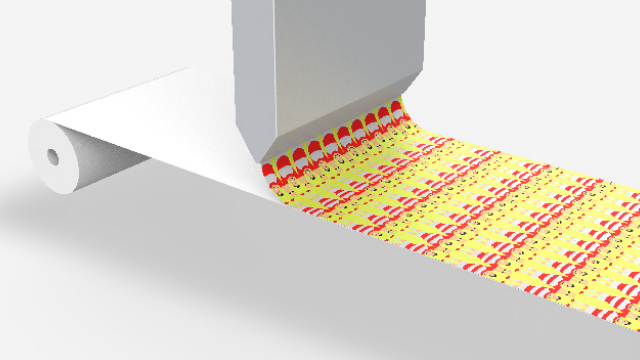
Process materials for multilayer ceramic capacitors
PVB is used as process materials for electronic components by leveraging its function to uniformly disperse inorganic fine particles and strength. The strength that prevents breakage when multiple thin layer sheets, whose thickness is several micrometers each, are laminated and the dispersibility that uniformly disperses and maintains fine particles of several hundred nanometers underpin technologies to fabricate microelectronic components.
Functions
- Strength
- Adhesiveness
 Dispersibility
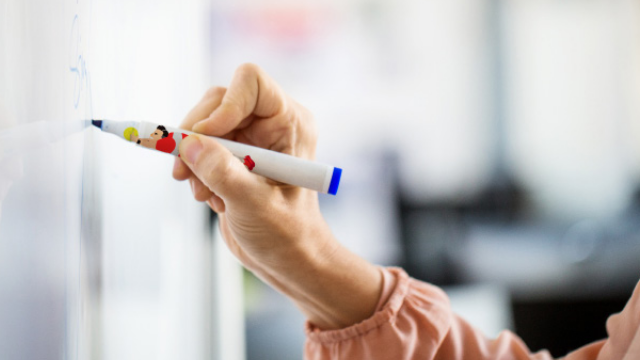
Uniformly dispersing ink pigments
PVB is used in inks. Uniform dispersion of pigments, which are used to color inks, achieves vivid color development or prevents printing on a smooth surface and printed matter from flaking off. The viscosity of inks can be adjusted. Low viscosity can increase the printing speed.
Functions
- Dispersibility
Adhesives for paper crafts
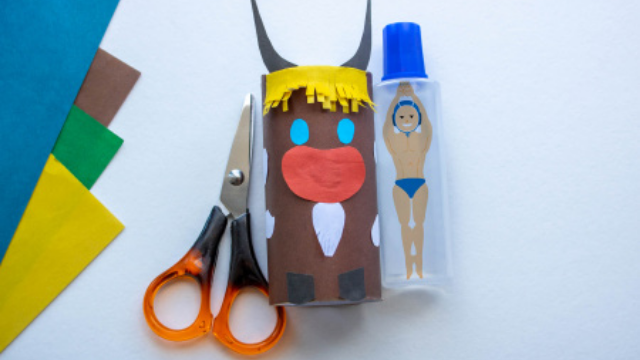
PVA is used in water glues for crafting. PVA has a high affinity for hydroxyl groups in cellulose and achieves excellent adhesion of paper. PVA glues are used for corrugated fiberboard, which is fabricated by adhering several types of paper. The glues are also present as a film on the back of postage stamps. Wetting the glues with water to slightly dissolve them enables adhesion between a postage stamp and postal matter made from paper.
Functions
- Adhesiveness
 Water solubility
Films that ensure wrapping and are washed away in the washing process
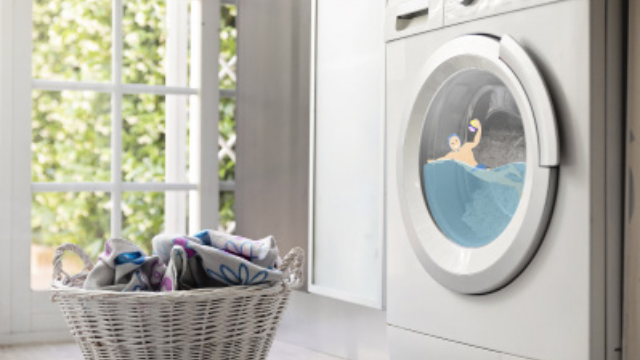
PVA films are strong and can be washed away, so they are used as wrapping materials for laundry detergents. For example, PVA films can be used to seal up used garments and instruments at medical facilities, making it possible wash and clean them without directly touching contaminated items. The films can also be used to wrap liquid detergents into small balls so that they can be handled as solid detergents.
Functions
- Adhesiveness
- Water solubility
 Safe materials
Coating agents for fibers
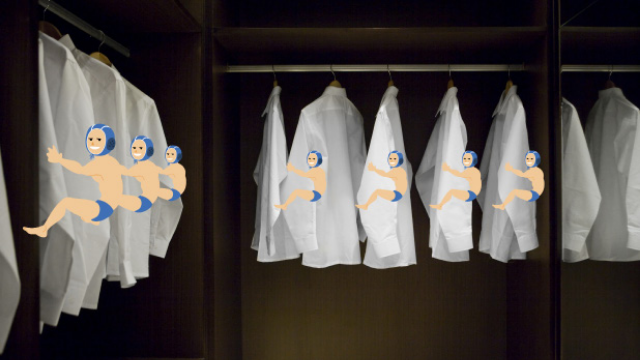
PVA coating films can be used as laundry starch to coat fibers. They not only make clothes crisp but also protect clothes from fouling. Dirt can be washed away with PVA glues in the washing process. For garments whose shape matters, such as yukata and shirts, loss of shape can be prevented by coating fibers.
Functions
- Adhesiveness
- Water solubility
- Safe materials
Introduction of products
S-LEC™films
Interlayer films for laminated glass
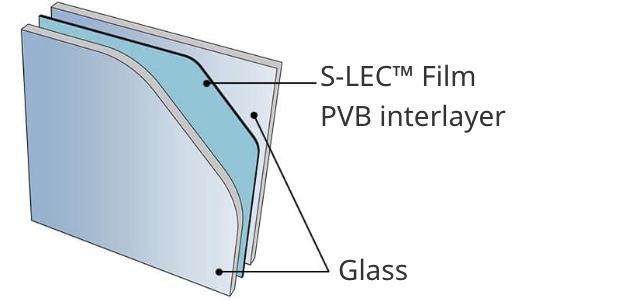
What are PVB interlayer films for laminated glass?
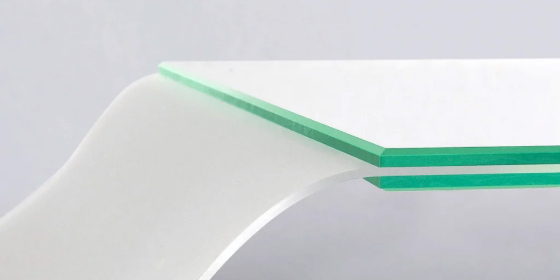
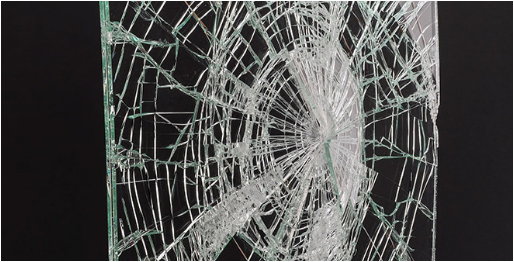
Laminated glass is a type of safety glass in which an interlayer film is placed between two sheets of glass and laminated at high temperature and pressure. Laminated glass using a PVB interlayer film is widely used as automotive windshields and side door windows and architectural glass, all of which require safety and security, due to the shatterproof function.
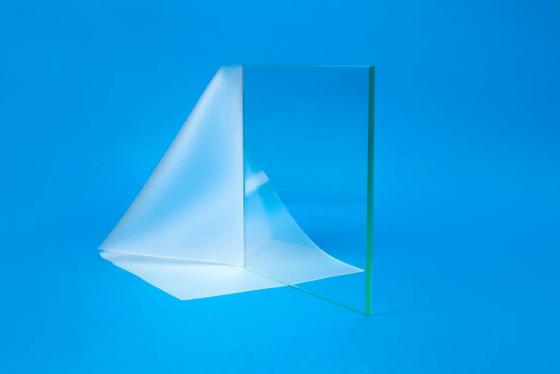
Capable of offering various functions and value
- Transparency – Maintain a clear vision
- Safety – Prevent shattering when glass is damaged and absorb impact
- Security – Delay destruction and penetration of glass
- UV protection – Block over 99% of UV rays
- Design – Colors and gradient
- Thermal insulation – Improve comfort in the cabin and buildings
- Sound insulation – Block noise entering from outside
- Head-up displays – Project clear images
Adhesive strength control
Adhesive strength control is an essential technology for ensuring the safety of laminated glass. By optimizing the adhesive strength for respective customers, we contribute to the quality stability of laminated glass.
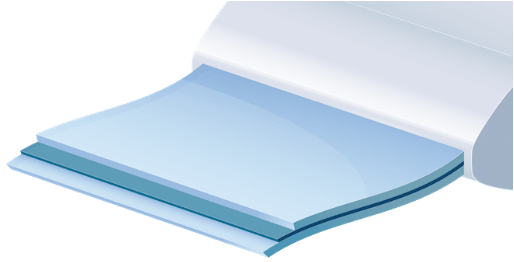
Multi-layer co-extrusion
Multi-layered interlayer films are formed by simultaneously extruding several layers from a mold. This technology makes it possible to manufacture interlayer films with various functions, such as the Wide Gradient Film and Sound Acoustic Film.
Fine particle dispersion
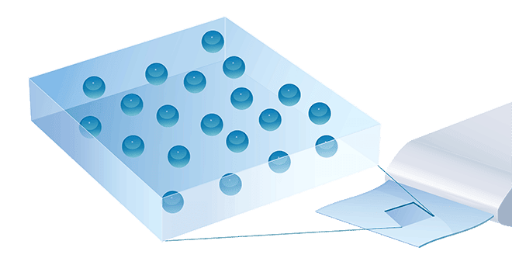
By dispersing functional fine particles uniformly in interlayer films, various functions can be exhibited. This technology contributes to the high functionality of the Solar Control Film and other products.
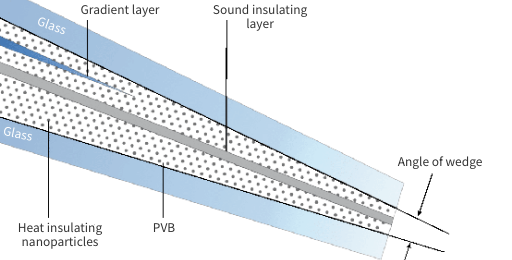
Wedge angle control
To display a clear image of a head-up display on the windshield, an interlayer film with an optimal wedge angle is required depending on the glass shape and installation angle. This angle control technology improves visibility for the driver, providing a more comfortable and safer driving environment.
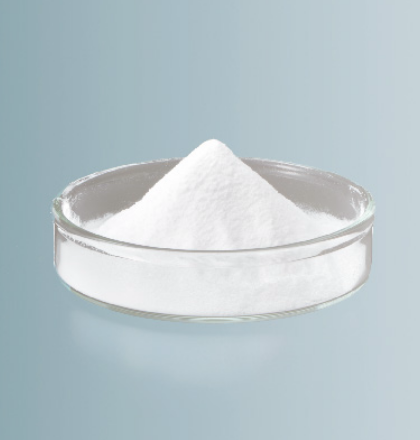
SELVOL
This is a PVA resin powder. It is used in fields where utmost care must be exercised in the usage environment (e.g., water-based adhesives).
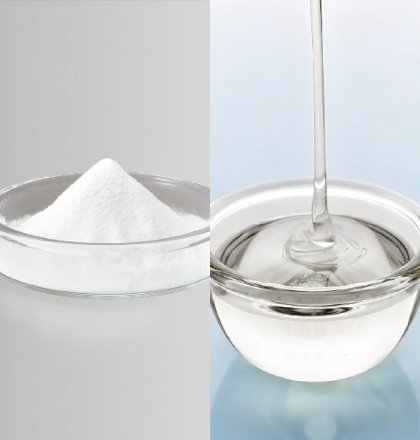
S-LEC™ B.K.
This is a PVB resin in a powder or granular form. Customers dissolve it in organic solvents, etc. to suit their usage. It is used for various applications, including printing inks, ceramic binders, and adhesives for substrates.